Would you like to make this site your homepage? It's fast and easy...
Yes, Please make this my home page!
The Perfect Captain
"Oh, for another regiment!"
Sir Isaac Brock, 1812
Welcome friend, to the page that asks, "King or Congress"?
---------------------------
Contact us
The Perfect Captain
---------------------------
Introduction
These rules were designed to include as much historical detail as we could without overly bogging down the game. You’ll find that armies are more constrained in their choice of activities than most freewheeling strategy game, but we feel this reflects the period. We are fortunate in that so many officers’ personal letters and official correspondences have survived, all of which show the frustration brought on by poor roads, lack of supplies and the insubordination of fellow officers. This is not to say that the game is slow. Proper planning and striking while the iron is hot will net you victory. Recognizing windows of opportunity to act even when you are not as prepared as you may like can be quite exciting, and you will find the campaign can be a real nail-biter.
Flow of Play
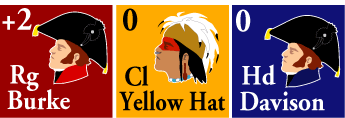
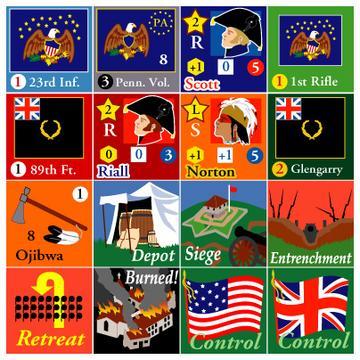
The game is Leader driven. His characteristics and qualities coupled with circumstances will dictate what a force can and cannot do. The closer you are to supplies, the more you can do- unfortunately you can’t win by sitting in a supply depot. A turn is played in operations. Players alternate operating with a force and Leader of their choosing, trying to outmaneuver their opponents and lever them out of commanding positions, opening up strategic objectives. Beware; although you may be only a mile or so from your objective, stretched supply lines, bands of guerilla fighters and incompetent Generals can force a sudden retreat, undoing careful planning.
A game of the american invasion of canada, 1814
for use with our Cousin Jonathan and john bull
miniatures rules
Be Aggressive!
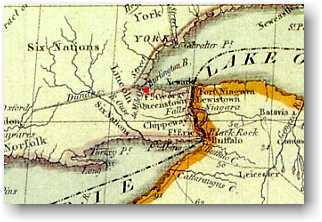
The board is divided into supply areas (colour coded) that can change due to territorial acquisitions. While the British begin with excellent supplies near Lake Ontario, the loss of Fort George can mean restricted movement in your own heartland. If the Americans lose Fort Schlosser, the British will have a free hand marching to Black Rock or Buffalo, causing the Americans to retire in shame from the Canadian side.
Battles, Skirmishes, and guerilla activity not only leads to the loss of men, but of confidence, and an army that loses hope will degenerate into an armed mob, incapable of organized action. Both sides were determined during this campaign, so battles tended to be hard fought, and cause high casualties, even among the Generals.
The Scale
The Niagara region in not a huge one. An army could march from the top to the bottom in two days (in peacetime).We use two day turns, which allows for the tiniest of actions and moves to be of significance. As far as troop scale is concerned all units used in play are called Detachments, which represent between 100-200 men. Thus the British 100th regiment (roughly 600 men) is composed of four detachments.
Is there a miniatures interface?
Of course..you're dealing with The Perfect Captain..
For Skirmishes and Guerrila actions, we have John Bull! For larger battles, the trusty Cousin Jonathan is available.
Also, battlefield, uniform, and historic site books printed by:
The Old Fort Niagara Society:
Uniforms and Equipment of the United States Forces in the War Of 1812
War Along the Niagara
The Niagara Historical Society:
The Battle of Queenston Heights
The Battle of Fort George
The Battle of Lundy's Lane
Osprey Books:
The American War, 1812-1814
Wellington's Army
Mackinac State Parks Society:
The British Army at Mackinac
Old Fort York National Historical Site:
The Battle of York
Fort Wellington National Historic Site
How about some Patriots links?
Causes of the American Revolution
A fairly unbiased account of the reasons for the Independence movement.
A rare find.................... (Sorry, the Captain is a Tory!)
The Patriot Resource
A good basic source of info on personalities and general background
Revolutionary War battles
A omprehensive list of engagements from the period
Uniform Guide
Painting up a few units? This will be of inestimable help