"I believe that in four weeks from the time a declaration of war is heard on our
frontier, the whole of Upper Canada and a part of Lower Canada will be in
our power."
- Representative John C. Calhoun, 1812
Welcome friend, to the page that asks, "King or Congress"?
---------------------------
Contact us
The Perfect Captain
---------------------------
A Free set of miniatures rules for the War of 1812 and
American Revolution, representing company level
actions of roughly 150-800 men per side, provided with
full colour graphics.
What are these rules about?
Well, these rules are, as already stated, the companion set to our previously published War of 1812 ruleset "Cousin Jonathan", which covered the war at the Battalion/Regiment level. It enabled you to fight any of the famous battles for the period such as Chippewa, Lundy's Lane, Sackett's Harbour, etc. While battles were generally small, (with 6000 participants total considered large), we felt that there was something missing for those interested in even smaller actions of the period. Further, while Cousin Jonathan is by no means a complicated game, it was decided to make a game that could be whipped together and played in a relatively short time. Thus, John Bull, and ultimately Patriots, the American Revolution variant.
What's different?
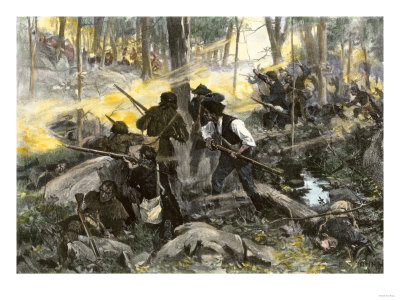
Well, for those of you who have played "Spanish Fury, Actions!", not a lot! You'll notice more than a passing similarity between these rulesets. Why? We felt the fun of cattle raiding and prison breaks to be quite diverting. Then we realized, with some modifications (for period flavour), North American warfare, with its forests and swamps, raids and counter-raids would be a perfect setting for this system. The War of 1812 was the obvious era to start with, followed by the American Revolution and a fan-created French and Indian Wars version (Mohican).
A companion game to Cousin Jonathan, sim'lating warfare of that smaller sort
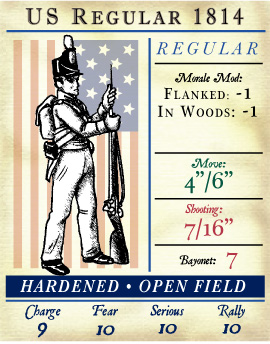
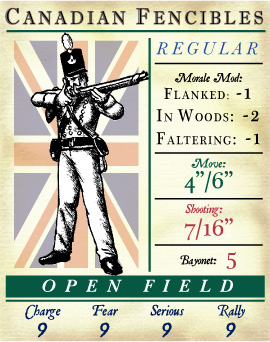
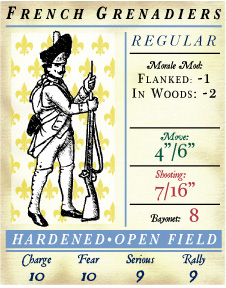
Useful graphics ease play
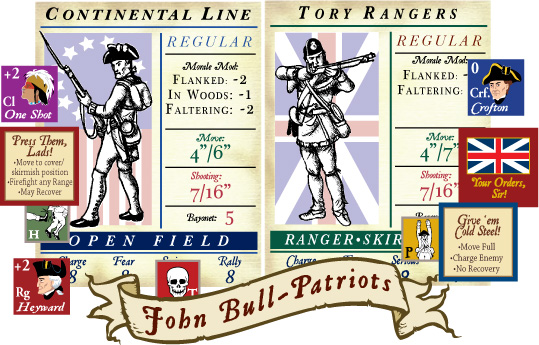
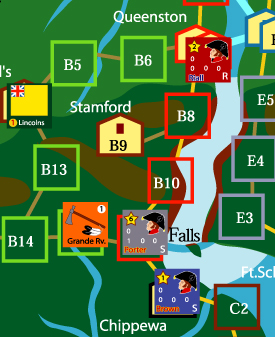
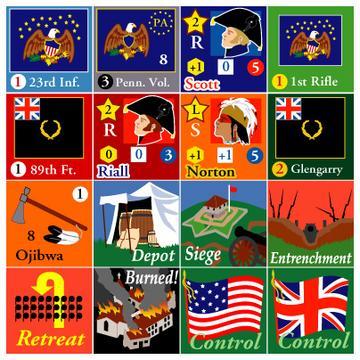
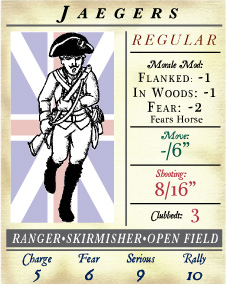
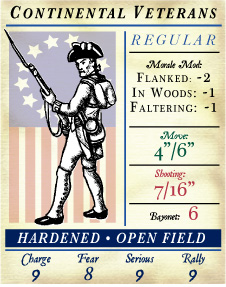
As far as the rules themselves they allow fast but hopefully historical play of smaller actions from the period. The entire northern front is the area we chose to simulate, with Indians, Kentuckians, Light Dragoons, Canadian Fencibles, British & American Regulars (several types), Volunteer Rifles, Turncoat Militia, Voyageurs- you name it, there's a separate card for it. In the Revolution, you'll find Brunswick Dragoons, Veteran Continentals, Tory Legion Infantry, and a pile of other cards. The game is so simple just about everything you need is on the unit card (about the size of a regular playing card; smaller, even). With a few of these in front of you, and the quick reference sheet, you won't be needing the rules after a game or two......
What kind of scenarios?
From Detroit to Montreal, we have TEN scenarios available for 1812 and SIX for the AWI, but have included a random force generator for those with a passion for "Design Your Own". The best part is, you never know what your enemy might be packing... are those "Regulars By G_d?" or are those "mere Militia"? Can I advance truimphantly, or am I walking into a trap? You'll never know until the game's over. The ten scenarios mostly cover actions from historical battles or skirmishes. Those keen on the period will recognize Purdy's advanced guard at Chateauguay, the last charge of Sir Isaac Brock, the beach landing at Little York, and many others.
What about personality......?
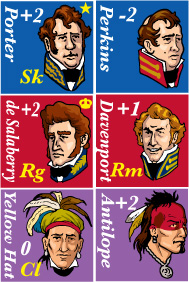
What's company level actions without a little extra flavour and some heroics? These gentlemen are "Heroes". In every game, you will have an officer in charge of the entire force, as well as a few "loose cannons" attached to individual companies (or Warbands). Some of these fellows will raise your morale, others lower it. Some can have taught their charges new skills, like Skirmishing and Ranger tactics. Clever officers can second guess their opponents, and get the drop on them. Still others might be the Romantic type of legends, exposing themselves to enemy fire in hopes of becoming legendary themselves.
What about the troops themselves?
You'll recognize all of your favorites- the Glengarries, De Meuron's Foreigners, Forsythe' Rifles, Scott's brigade, Tecumseh's Shawnee. In fact, no two troop types are alike. Some are Hardened, and can face casualties with ease. Some are Careful, and won't stick around when they get shot at. Some perform well in the Open Field, while Rangers prefer the woods. Skirmishers are hard to get a bead on. Some troops fear other, specific units, such as Sedentary Militia being afraid of everything except Sedentary Militia. Others, like British Grenadiers, fear nothing.
What's the scale? How many figs will I need to play?
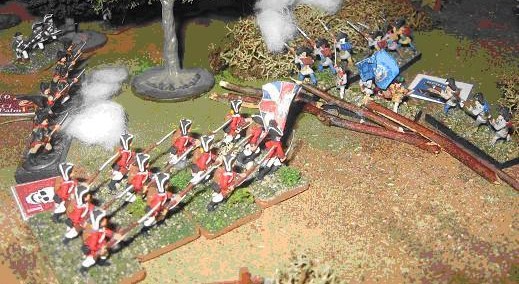
A stand of three figures is about 25 actual men, and an inch about ten paces.You can play with as few as 20 figures,or as many as one hundred. It's up to you. You won't have to rebase your army to play with these rules, by the way, just about anything will do. And there's no individual figure removal. As per the Captain's secret protocol, there is no record keeping! Burn your pens, pencils, and paper!
Can you give us an idea of the flow of play?
Why, certainly. Each force is divided before play begins into companies, some of which may be led by Heroes. Each turn, players alternate acting with an individual company to move, shoot, hide, rustle sheep, jump into or out of boats, manhandle cannon, stop running away, etc. Some Heroes are Clever. These officers can attempt to preempt an enemy company's actions by performing his own first, thus giving his side a sort of double turn. Otherwise companies keep alternating their actions, getting into firefights, sometimes charging with the bayonet, until the other side has run off or had their army morale shattered. The play is fast and amusing.
Is this related to Cousin Jonathan or Obstinate Beyond Description?
Of course! Every troop type in CJ is present in JB, with simple conversions available. Both of these systems are integrated into our campaign game (Obstinate Beyond Description)
Also, battlefield, uniform, and historic site books printed by:
The Old Fort Niagara Society:
Uniforms and Equipment of the United States Forces in the War Of 1812
War Along the Niagara
The Niagara Historical Society:
The Battle of Queenston Heights
The Battle of Fort George
The Battle of Lundy's Lane
Osprey Books:
The American War, 1812-1814
Wellington's Army
Mackinac State Parks Society:
The British Army at Mackinac
Old Fort York National Historical Site:
The Battle of York
Fort Wellington National Historic Site
How about some Patriots links?
Causes of the American Revolution
A fairly unbiased account of the reasons for the Independence movement.
A rare find.................... (Sorry, the Captain is a Tory!)
The Patriot Resource
A good basic source of info on personalities and general background
Revolutionary War battles
A omprehensive list of engagements from the period
Uniform Guide
Painting up a few units? This will be of inestimable help
Southern Campaign.....
Campaign!
A rival ruleset and campaign system... well done! We think this looks really good.
RevWar Spies!
Check out this page covering the behind the scenes espionage
and the persons involved.
Thanks Sarah!
do you like After Action Reports?
Us too! click on the image below for a full replay of a battle for John Bull and another for Patriots!
Check out the new cover we made for the rules!
Partisans!
Including new cards , leaders and scenarios for:
The Kings Royal Regiment of New York, and another for Armand's Legion